Thursday, March 27, 2014

A life in checks and balances

I'm bored by math, can't balance my checkbook without a full-time handholder, and struggle even to write checks (so many steps!). Yet it has been revealed to me through the deaths of various relatives that one of the most interesting ways to get to know people or to learn their secrets is to have your nose rubbed in their financial affairs.

In the wake of my father's death, my brother and sister-in-law have taken responsibility for writing paper checks for my mother’s bills. I’ve been tasked with monitoring my mother’s bank account and paying the two "V" bills online: the Visa card and the Vista condo monthly dues. But here's the thing: even with this minimal involvement in my parents' financial life, I am learning and being reminded of interesting details about my father:

In addition to being hospitalized four times in the last month of his life, which I knew about, my father required three visits from the fire department to get him back on his feet after he’d fallen. My father was a big man: 6 ft. 4 in. He was slender at the end, but too difficult for the tiny home aide to maneuver. The touching thing is that he never told me about these falls and apparently forbid anyone else to do so, even though I called every day or two and visited frequently, so there was ample opportunity. He didn’t want to worry me. I feel guilt now, a form of retroactive worry I suppose.

My brother was finally able to cancel my parents’ paid AOL account yesterday. I had often suggested it, but my father insisted that it provided “security” and refused to let it go, even though it cost him $29.99 a month in return for absolutely nothing. My mother’s verbal skills declined after her stroke, and my father was deeply paranoid about electronic media. He was convinced the CIA was collecting information about him for his anti-war work in the ‘70s and his trips to Egypt in the ‘80s and ‘90s. Could be true.

My parents put their money where their beliefs were. Every month there were donations to the Unitarian church, Amnesty USA, the Museum of Fine Arts, the Mendocino Music Festival, the ACLU, Compassion & Choice, Doctors Without Borders, Viet Veterans of California, and the Multiple Sclerosis society. The last was in honor of his dear friend Wally, who died of pulmonary fibrosis, a diagnosis that somehow got transmuted into m.s. in my father’s mind; when I pointed out the real diagnosis to him, he insisted they were the same thing, and anyway, Wally would have liked having money donated to m.s. too.

The National Pen Company made hundreds, perhaps thousands, of dollars from my father, who ordered hundreds, perhaps thousands, of pens and flashlights imprinted with “Valley of the Kings Research,” an organization that has not existed for several years. My father gave out these trinkets by the dozen to friends and visitors. There are hundreds of them still secreted away throughout the apartment. We put out a basket of them at his memorial service, but takers—and there were many—barely made a dent in the supply.

If my father liked a book, he bought 10 or 20 copies to give away. I ordered them for him on Amazon, so I have a list of recent favorites: “Being Wrong,” by Kathryn Shultz; “I Am Malala,” by Malala Yousafzai; “Miramar,” by Naguib Mahfouz; “Shahhat,” by Richard Critchfield; and “To Forgive Design: Understanding Failure,” by Henry Petroski. 

My parents’ living expenses were modest—except for their 24-hour-home-care bill of $400 a day, $600 on holidays. They had paid off their condominium and no longer traveled. Their biggest expense outside of their home aides was food: hefty portions of meat at every meal for my farm-boy father, bushels of nuts for snacking, as well as carbs aplenty in the form of pies, cakes, cookies, crackers, cupcakes, bagels and muffins. As for the home care, it was necessary for survival. My parents had eschewed any form of institution as too confining. In the end they were imprisoned in their beautiful hilltop condo, the steep incline preventing them from setting foot outside. The isolation and tedium drove them both a bit crazy.

So there in a check register is the story of a life, or a part of one.


Friday, March 21, 2014

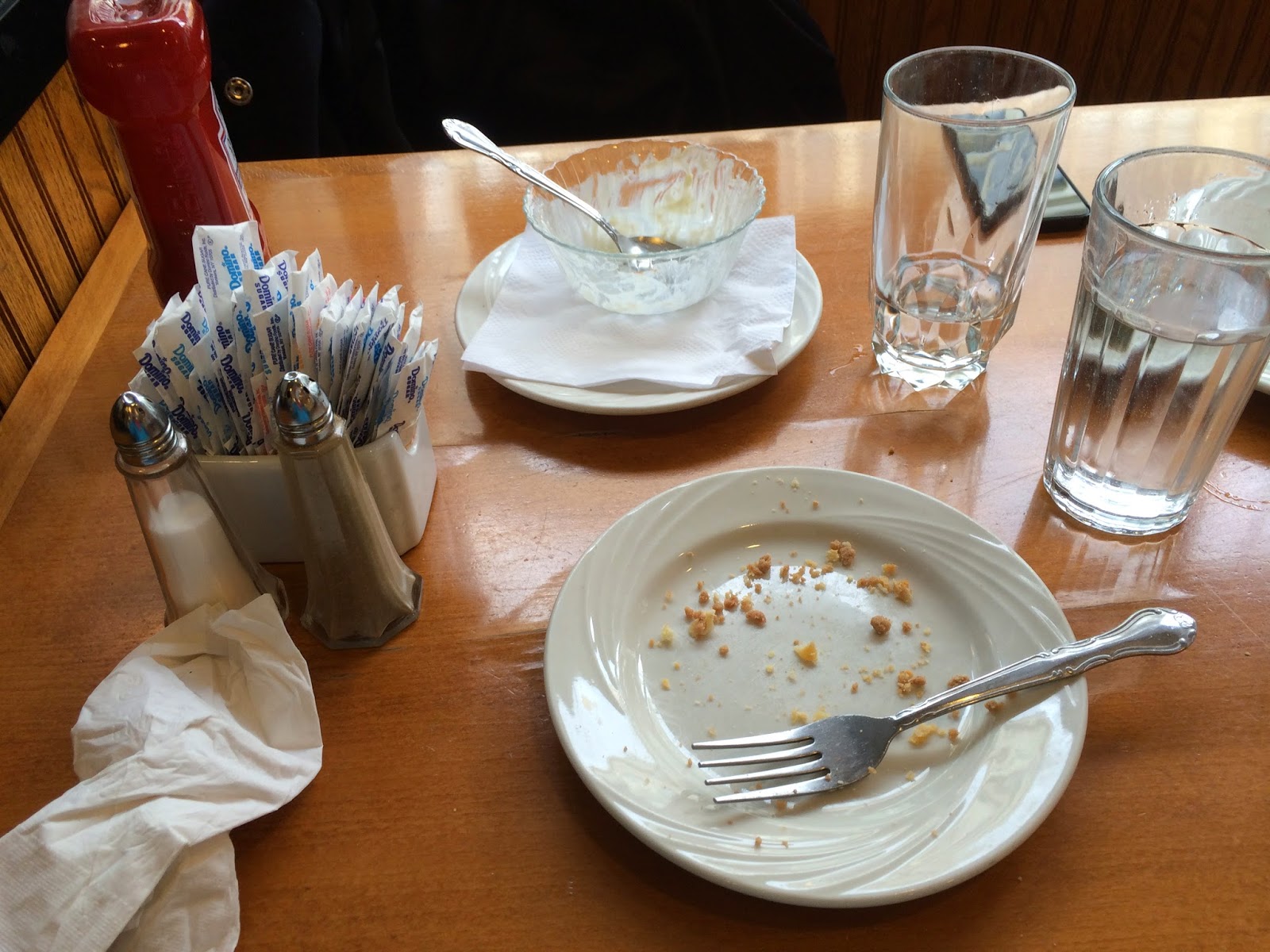
Remnants of Things Repast


Footnote

Yesterday in a yoga class at Iyengar, another student asked me whether I was a dancer. “No,” I said, “but I’m flattered you asked.” Then I realized she was looking at my feet and it was not a compliment.

Thursday, March 13, 2014

Dying days

It’s probably always a jolt when a parent dies, but I can’t claim I wasn’t warned about my father’s death. He was 90, and he’d been talking to me for the past year about dying. 

He and I spent days poring over questions like “If I am unconscious, in a coma or in a persistent vegetative state and there is little or no chance of recovery ... I would [want/not want] to have life-sustaining treatments.” That one was easy for both of us. 

But other questions were more perplexing: Would he want to have regular life-sustaining treatments like, say, dialysis if he were mentally competent but unable to communicate? It would depend. Many of the questions remained in the limbo of “it would depend.”

He was excited about dying. He talked about it constantly. He formally enlisted an old friend to be his “advance-care agent” and put her on his list of emergency contacts. In the end, though, he didn’t need her services. 

He was hospitalized four times in his last month of his life. His lungs kept filling with fluid, making it hard for him to breathe. He wasn’t expected to survive the third hospitalization, so I flew out to have a chance to see him before he died. When I arrived, at midnight, he was awake and pleased to see me. “I pulled my plug!” he announced excitedly, holding up his arm, with its new DNR wristband, in an air punch of victory. But after he had signed the DNR, he allowed doctors to remove fluid from his chest once again—which revived him. 

I spent five days at his bedside, during which time he told me that he had had a wonderful marriage, and a wonderful life. This seemed like good news, since he had been depressed during much of the past year. 

One day he greeted me by telling me cheerfully, “I’m wearing women’s pants!” (They weren’t really women’s pants, but sweatpants with an elastic waistband, a style he identified with my mother.) 

When his nurse asked him how he was, he told her, “I’m a loser. I’m an engineer, and my whole career I’ve been fighting the natural forces that eventually destroy all things: wind, fire, water, air, heat, cold. And now I’m fighting disease, and I’m losing.” 

When Other called him and asked him how he was, my father said delightedly, “I’m wearing diapers!” 

Everything about the process of leaving the living world fascinated him—and made him seem more alive than ever. It was as though he had been bored by the tedium and stress of a life that had devolved into paying bills and preparing his taxes. But dying—now that was interesting!

Shortly after he was discharged and I left him to fly home, he was hospitalized again. This time he was resolute. He demanded to be sent home. “I can’t live like this,” he told me on the phone. By the time my brother and sister-in-law arrived, he had yanked out his chest drain. They took him home to the apartment he shared with my mother and their home aide, and within 24 hours he was gone. 

Before he died, he underwent a process called “terminal agitation,” thrashing and trying to throw himself out of the hospital bed that the hospice service had set up in the living room. It took all my brother’s strength to subdue him. At one point, my brother and sister-in-law called me and asked me to try to talk to him on the phone to see if I could calm him down. “Dad,” I said. “Everything is o.k. You don’t need to worry about anything. The bills are paid, and we’ll take care of Mom.” Those were the last words I spoke to him.

They tell me that he seemed calmer after that. He continued to mutter unintelligibly, occasionally breaking into coherence. He told my sister-in-law, “You have given me a great gift” (apparently alluding to her help in arranging for him to die at home rather than in the hospital). He shouted out at one point: “I’m going … to Death!” And at 8 in the morning, he uttered his old familiar catchphrase, “Take care, and have fun!”

I struggle to remember anything from my childhood about my father. But images of his old age and dying are vivid—and infinitely touching.

The dark before the light

There was a dark period in my life when I was a child entering adolescence. I was a loner, a reader and a raisin-eater, and I had an obsessive fear of death that kept me awake at night. My fear of death was intertwined with my fear of math. I lived in the country, in a house cantilevered over a steep hill. Someone had told me about infinity. And I lay awake many nights, projecting my mind incrementally forward “… plus one, plus one, plus one …” 

Infinity terrified me. It was logical and simple but unreachable, and propelling myself toward it felt like falling into a bottomless chasm. It sucked the air out of me. 

It was a period when my parents quarreled a lot. I don’t know what they fought about—maybe it was about me and my brothers—but the fights often culminated in one or the other of them raging into the night. A car door would slam and then brakes would screech as the car careered down the treacherous winding road toward the flatland below. So as one part of my mind was inching toward eternity, another part was straining to catch the receding racket of the car.

That wasn’t the only time math and parental anger were joined. Though it was clear that math was not my strong suit, my parents, in an excess of feminist fervor, insisted that I be placed in the advanced class in junior high school. I languished there, stupid and embarrassed, my misery compounded by my being one of only two girls in the class. My dread of math—and of my parents' sure anger—hung over me throughout the day, with just a brief respite between sixth period, when the class took place, and later in the afternoon, when I started in on my homework. On weekends, my father would tutor me. These coaching sessions would begin with patience and good will and end in fury and tears. My father, a structural engineer, could not fathom that anything but stubbornness could account for my stupidity. It was a relief to us both when the school placed me in the regular track the following year. This time my parents did not intervene.

Then there were the taxes. When I was 16, my father said he’d pay me to code his receipts for the year and add them up. It was simple in concept, but the coding was an elaborate scheme, with dozens of categories and subcategories. And the receipts overflowed a large grocery bag. It was a big job—overwhelming in scope and importance—and I muffed it. I knew I was muffing it, even as I did so. As I waited for him to discover the mess I had made of things, I swam in a sea of dread—of my father and of the IRS. When he finally began to plug in the bogus numbers I had assembled, my father reddened and roared at my “carelessness.” I called him a “swine,” a peculiar word—I have no idea why it came out of my mouth—that ignited an explosion of wrath. My father was six foot four and burly, and he seemed to swell with rage. I was scared and humiliated. His rage eventually burnt off, but its toxic cinders lingered in the air. We didn’t speak for weeks. One of the enduring residues of that episode was a deep fear of growing up and having to do my own taxes. 

But adulthood turned out to be a lot easier—and happier—than childhood. I learned that for a small fee, an accountant would do my taxes. And balancing my checkbook is about the only task I’ve ever had to do that involved math of any kind. Infinity I still struggle with, oddly when I meditate. I get that free-fall feeling when I try to let go of the past and of the future, and focus on the now. That now … plus now, plus now, plus now … feels a lot like eternity.

Saturday, March 8, 2014

The swimmer

For several years in the early 1960s, before I became a teenager, my skin flaked and stank of chlorine, my eyes were shot with red, and my short hair gleamed green. As a competitive swimmer, I had a three-hour workout every summer morning and a two-hour practice every evening, except on Sundays, when there was no evening practice. My mother hired a teenage boy to drive me home from the later practices, which let out after dark. But I walked to and from the morning workouts. The long laps in the fifty-meter pool required a certain kind of courage—physical endurance. But the journeys on foot required another kind—the fortitude to be on my own in an unpredictable world.

Although I had two brothers, my habits were those of an only child. Sometimes I read a book as I trudged the 45 minutes over the hills and across the valleys between my house and the pool at the community college. Other times, I constructed an elaborate serial fantasy in which I starred as Super M, with adventures similar to Superman’s, but without Lois Lane or a day job. Alone and brave, I saved a lot of people, and they were sorry they never knew my name.

Back then the human population was sparse in Los Altos Hills, but apricot trees and horses were thick. My route took me cross-country, behind the Immaculate Heart Monastery of the Poor Clares (whose nuns I never glimpsed), and through high grasses, across orchards carpeted in fallen fruit, and down unpaved trails rank with horse dung and deer pellets.

Not infrequently, danger jolted me from my book or from my Super M reveries. Yellow jackets buzzed me, angry at my intrusion on their feast of rotting apricots. Or the dry grasses would rustle, signaling the passage of a snake, probably a harmless gopher snake, but possibly one of its lookalikes, the venomous rattlers that matched their five-foot length and diamond markings. I was never bitten, but I stood motionless for long minutes, as I had been instructed to do, waiting for the snake to make its way out of striking distance.

The most terrifying encounter of my swimward trek was with a species known for its docility. One day, as Super M was soaring through the skies toward another daring rescue, a vibration beneath my feet shook me from my dream. For a moment, I couldn’t see the source of the rumbling, which was punctuated by something like a baby’s cry—an eerie, not-quite-human baby’s cry. Then I turned.

Surging toward me from behind was a great, dirty, gray mass, almost liquid in its undulations. The mass was made up of a hundred bleating sheep stampeding toward me. I froze, as if to appease a diamondback. But the mob, moving as a single beast on 400 pounding legs, showed no sign of dividing to pass around me. Their alien yellow eyes, bisected by horizontal pupils, stared at me unblinking and blind. And suddenly I was down, choking on dust, pummeled by hooves as they roared over me like a freight train.

I was bleeding and bruised when I reached the pool, and in shock. For once I didn’t linger on the edge, didn’t put off the chilly plunge. The cool clean water parted as I dived into my lane, which was neatly separated from the next by a rope of thick beads. The numbing fear began to wash away as I fell into the familiar rhythms of kicking, stroking, breathing. As Cheever wrote, “To be embraced and sustained by the light green water was less a pleasure, it seemed, than the resumption of a natural condition.” 

My swimming career came to an end after I reached puberty. Menstrual cramps kept me from practice several days a month, and I slipped behind my teammates. Free of chlorine, my eczema cleared up, and my hair grew out a dirty blond. My fantasies turned from Super M rescuing the world to boys rescuing me. 

New McMansions and a great expressway now block the route between the house where I grew up and the pool where I swam. The apricot trees have all but vanished, and no one keeps sheep anymore. But every year, even now, a dozen people are bitten by rattlers. Almost all of them survive.


Friday, March 7, 2014

Stimulant dreams


I’ve been having a series of nightmares about our drip coffeemaker. In one, I put the coffee in and flip the switch before realizing I have forgotten to place the paper filter. In another I put in too much water and can’t turn the machine on. These dreams are terrifying.